Nobody clicks "check for risks" on the morning it would have mattered. That is the structural problem with request-response intelligence in a planning tool: a stale blocker is only useful information if somebody notices it on day three rather than day nine.
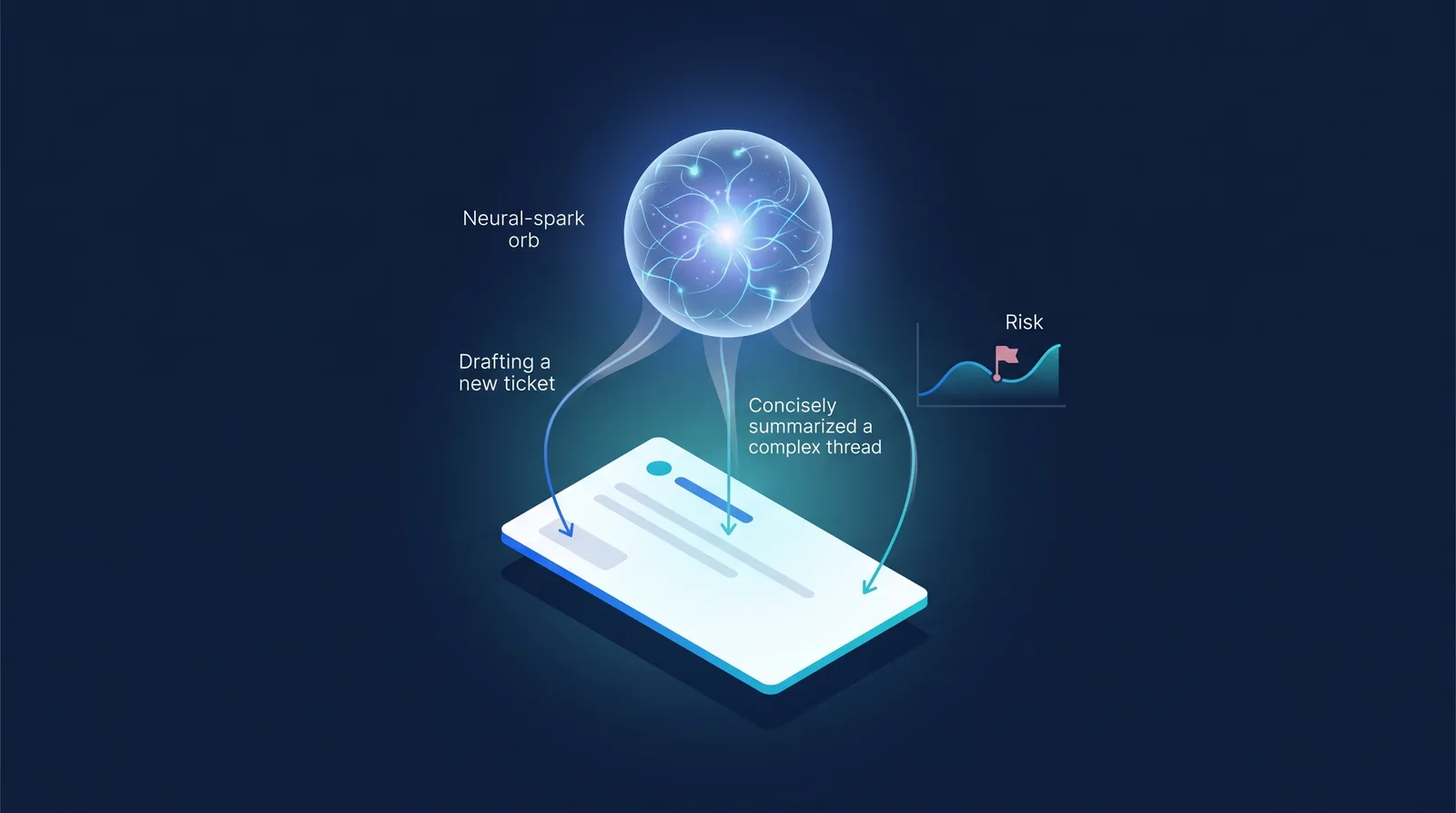
The designed at-risk decision reads what PlanMagnet already holds — work-item staleness, the explicit dependency graph, sprint dates and burn-rate, assignee load — and returns per-item risk with a stated, human-readable reason. Not a score out of a hundred. A sentence: this has not moved in eleven days; this is blocked by that specific item; this assignee is committed past capacity; this sprint's burn-rate implies a miss. A reason is actionable in standup in a way a number never is.
Because PlanMagnet's dependency relationships are real records rather than text conventions, "blocked by" can be traversed instead of inferred, and a flagged item can point at the specific thing standing in front of it. Where a flag deserves to become a tracked risk, the design routes it through PlanMagnet's existing risk register on human confirmation — it does not silently create risk records.
The second half is cadence. The design gives PlanMagnet's domain three natural beats: a daily sweep for what stalled and what is newly blocked, a mid-sprint health check timed off the sprint's own dates for while cutting scope is still possible, and a weekly roadmap-drift check for initiatives whose delivering epics have slipped. Scheduling is designed to run on the platform's workflow automation rather than a bespoke cron, per-workspace behind a feature flag with an off switch, with a spend pre-flight so a background loop can never quietly burn a workspace's AI budget, and with de-duplication so an unchanged flag does not re-notify every morning.
Both halves are committed roadmap. Today PlanMagnet ships the substrate they depend on — the dependency graph, sprint history, burndown and velocity, and a risk register with likelihood × impact scoring — but no at-risk decision and no autonomous sweep exist in the service yet, and this story describes design rather than current behaviour. This story is narrative-only today; the interactive app walkthrough is not yet available.
Ready to make this your story?